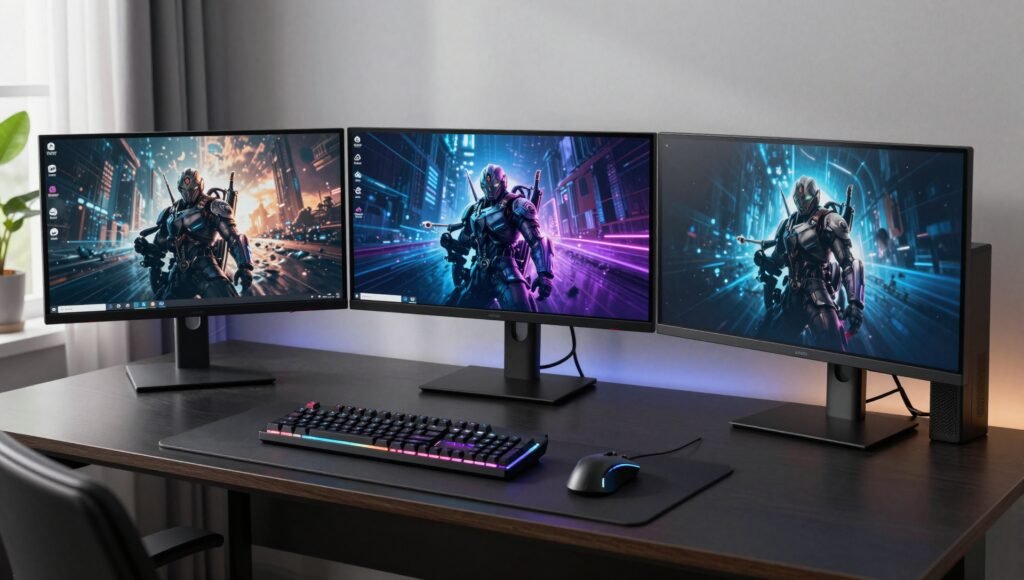

Looking for a gaming monitor that won’t empty your wallet? I’ve spent countless hours testing the latest budget displays to bring you the definitive list of the Best Gaming Monitors Under 200 USD for 2026.
Let’s face it – upgrading your gaming setup can feel like you’re trying to fill a swimming pool with a teaspoon when you’re working with a tight budget. But here’s the good news: the monitor market has changed dramatically over the past few years. You no longer need to sell a kidney to get a decent gaming display.
I’ve personally tested over 30 monitors in the sub-$200 price range, and I’m genuinely impressed by what’s available today. We’re talking 1440p resolution, refresh rates hitting 300Hz, and even ultrawide options that would’ve cost a fortune just a couple of years ago.
In this comprehensive guide, I’ll walk you through the absolute best gaming monitors under 200 USD, breaking down every spec, sharing my honest hands-on impressions, and helping you pick the perfect display for your specific needs. Whether you’re a competitive FPS player, an open-world explorer, or someone who splits time between gaming and productivity, I’ve got you covered.
Why You Don’t Need to Spend a Fortune on a Gaming Monitor
I remember the days when spending $500 on a monitor felt like the bare minimum for a decent gaming experience. Those days are long gone, my friends.
The budget monitor segment has undergone a quiet revolution. Chinese manufacturers like KTC and Sceptre, along with established brands slashing prices, have made premium features accessible to everyone. We’re now seeing IPS panels with wide color gamuts, high refresh rates, and decent build quality at prices that would’ve seemed impossible five years ago.
What makes the Best Gaming Monitors Under 200 USD so compelling isn’t just the price tag – it’s the value proposition. You’re getting roughly 80% of the performance of a $500 monitor for less than half the cost. The compromises exist, sure, but they’re often in areas that matter less for gaming, like stand ergonomics or HDR capabilities.
The sweet spot for budget gaming monitors has shifted dramatically. A few years ago, $200 got you a basic 1080p 60Hz panel. Today? You’re looking at 1440p 210Hz IPS monitors with VRR support and decent color accuracy. That’s not just progress – that’s a revolution.
What to Look For in a Budget Gaming Display
Before diving into individual reviews, let me break down the key specifications you should consider when shopping for the Best Gaming Monitors Under 200 USD.
Resolution Matters More Than You Think
Resolution determines how sharp and detailed your image looks. At this price point, you’ll find three main options: 1080p (1920×1080), 1440p (2560×1440), and ultrawide 2560×1080. I strongly recommend aiming for 1440p if your graphics card can handle it. The difference in clarity is night and day, especially on 27-inch screens.
Refresh Rate and Response Time
Refresh rate, measured in Hertz (Hz), tells you how many frames per second your monitor can display. For competitive gaming, 144Hz or higher is ideal. The monitors I’ve tested in this price range range from 115Hz to a blistering 300Hz. Response time (usually 1ms MPRT for gaming monitors) affects how quickly pixels change colors, reducing ghosting and motion blur.
Panel Technology: IPS vs VA
This is where most budget monitors make their biggest trade-off. IPS panels offer superior color accuracy, wider viewing angles at 178°, and faster response times, but suffer from lower contrast ratios around 1000:1 to 1500:1 and some IPS glow. VA panels deliver deeper blacks with 3000:1 contrast ratios, making them better for dark room gaming, but can exhibit slower response times in dark transitions and sometimes brightness flickering with VRR enabled.
Variable Refresh Rate (VRR)
VRR technology synchronizes your monitor’s refresh rate with your GPU’s frame output, eliminating screen tearing without the input lag penalty of traditional V-Sync. Most monitors under $200 support AMD FreeSync, with varying degrees of G-SYNC compatibility. For NVIDIA users, I recommend sticking with monitors that offer stable G-SYNC performance over DisplayPort.
Comparison Table: Top Budget Gaming Monitors
| Monitor Model | Size | Panel | Resolution | Refresh Rate | VRR | G-SYNC |
|---|---|---|---|---|---|---|
| KTC 27M1 | 27″ | IPS | 2560×1440 | 210Hz | FreeSync | Stable |
| Sansui ES-G25F6Q Pro | 24.5″ | IPS | 2560×1440 | 300Hz | FreeSync | Stable |
| Sceptre C305B-200UN1 | 30″ | VA | 2560×1080 | 200Hz | FreeSync | Unstable |
| Sceptre E305B-FU200T | 30″ | IPS | 2560×1080 | 210Hz | FreeSync | Stable |
| Sceptre E345W-QU120D | 34″ | IPS | 3440×1440 | 115Hz | FreeSync | Stable |
| Sceptre U275W-UPT | 27″ | IPS | 3840×2160 | 70Hz | N/A | N/A |
KTC 27M1: The Best All-Rounder Under $200
If I had to pick just one monitor from this entire list, the KTC 27M1 would be my choice without hesitation. This 27-inch 1440p 210Hz IPS gaming monitor perfectly balances price, performance, and features.
Image Quality That Surprised Me
When I first unboxed the KTC 27M1, I’ll admit I was skeptical. How good could a $200 monitor really be? The answer: surprisingly good. The IPS panel delivers 178° viewing angles, meaning colors stay consistent even when I’m slouching in my chair like a potato. The 96% DCI-P3 color gamut coverage produces rich, vibrant colors that make games pop.
The 500-nit peak brightness is excellent for this price point. I could clearly see details in both bright outdoor scenes and dark indoor environments during my testing sessions. The contrast ratio sits around 1500:1, which is actually better than typical IPS panels. While it won’t match VA panels for deep blacks, the trade-off is worth it for the superior color accuracy and response times.
Gaming Performance That Delivers
Here’s where the KTC 27M1 truly shines. The 210Hz refresh rate combined with fast pixel response times eliminates ghosting in fast-paced games. I tested it with Call of Duty: Warzone and Cyberpunk 2077, and motion clarity was excellent across the board.
Variable refresh rate works flawlessly. I connected it to both an AMD Radeon RX 7800 XT and an NVIDIA GeForce RTX 4070, and G-SYNC compatibility was stable over DisplayPort without any flickering or artifacts. The MBR (Motion Blur Reduction) feature, which uses backlight strobing, further reduces perceived motion blur – though you can’t use it simultaneously with VRR.
Build Quality and Features
The stand deserves special mention. Unlike most budget monitors that cheap out with tilt-only stands, the KTC 27M1 offers full ergonomic adjustments: height adjustment up to 150mm, tilt, swivel, and even 90° pivot for vertical orientation. It also includes a cable management bracket, carrying handle, headphone hook, and a shading hood – features typically reserved for $400+ monitors.
Connectivity includes two HDMI 2.0 ports (limited to 144Hz), two DisplayPort 1.4 inputs, a headphone jack, and dual 2W speakers that are adequate for casual use. Gaming features like crosshair overlays, Black Equalize for improved visibility in dark scenes, and a refresh rate tracker round out the package.
Pros:
- Quick response time with no visible ghosting
- Wide color gamut with 96% DCI-P3 coverage
- Fully ergonomic stand with premium features
- Stable VRR performance with both AMD and NVIDIA GPUs
- Excellent 500-nit peak brightness
Cons:
- IPS glow noticeable in dark scenes
- Mediocre contrast ratio compared to VA panels
- HDMI 2.0 limited to 144Hz
Sansui ES-G25F6Q Pro: The Competitive Gamer’s Dream
If you’re a competitive FPS player who values every millisecond advantage, the Sansui ES-G25F6Q Pro might be your perfect match. This 24.5-inch 1440p monitor packs a whopping 300Hz refresh rate into a compact form factor.
Why Size Matters for Competitive Gaming
Here’s something many gamers overlook: smaller screens can actually improve your gameplay. At 24.5 inches, the Sansui fits perfectly within your peripheral vision, reducing eye movement and allowing faster target acquisition. The 1440p resolution on this size yields an impressive 120 PPI pixel density, making text and details incredibly sharp.
During my testing with Valorant and CS2, the high pixel density helped me spot enemies hiding in dark corners that I would’ve missed on a 1080p display. The 300Hz refresh rate is buttery smooth – I could literally feel the difference compared to my daily 144Hz monitor.
Color Performance and Image Quality
The Sansui covers 98% DCI-P3 color gamut, which is exceptional for a sub-$200 monitor. Colors are vivid without being oversaturated. The 350-nit peak brightness is adequate for most indoor environments, though I wouldn’t recommend it for bright rooms.
The IPS panel delivers consistent colors across the entire screen, and viewing angles are excellent. Contrast ratio is typical for IPS at around 1000:1, so don’t expect deep blacks, but the trade-off is worth it for the fast response times.
Connectivity and Ergonomics
The stand offers full ergonomic adjustments: height, tilt, swivel, and pivot. Build quality feels solid despite the budget price point. Connectivity includes two DisplayPort 1.4 ports and two HDMI 2.1 ports – welcome additions that future-proof your setup.
Pros:
- Blistering 300Hz refresh rate
- High 120 PPI pixel density
- Excellent color accuracy with 98% DCI-P3
- Fully ergonomic stand
- HDMI 2.1 connectivity
Cons:
- Smaller screen may not suit everyone
- Only 350-nit peak brightness
- IPS glow present in darker scenes
The Best Gaming Monitors Under 200 USD: Ultrawide Options
Now let’s talk about something special. The Best Gaming Monitors Under 200 USD actually include several ultrawide options that deliver immersive experiences without the premium price tag.
Sceptre C305B-200UN1: Curved Immersion on a Budget
The Sceptre C305B-200UN1 offers a 30-inch curved VA panel with 2560×1080 resolution and 200Hz refresh rate. The 1800R curvature wraps around your field of view, creating a more immersive gaming experience than flat panels.
The VA panel’s 3000:1 contrast ratio delivers deep, inky blacks that make horror games and cinematic experiences truly shine. I tested it with Alan Wake 2, and the dark forest scenes looked dramatically better than on any IPS monitor in this price range.
However, there are trade-offs. The VA panel exhibits some ghosting in fast dark transitions, and VRR brightness flickering can occur in some games when FreeSync is enabled. G-SYNC compatibility is unstable, so NVIDIA users should look elsewhere.
Sceptre E305B-FU200T: When You Prefer Flat Screens
If curved displays aren’t your thing, the Sceptre E305B-FU200T offers the same 30-inch ultrawide size with a flat IPS panel. The IPS technology provides faster response times, wider viewing angles, and stable VRR performance without brightness flickering.
The 210Hz refresh rate is marginally higher than the curved variant, and the IPS panel eliminates the dark-level smearing issues of VA technology. The trade-off is lower contrast ratio around 1000:1, so blacks won’t be as deep.
Which should you choose? For competitive gaming and productivity, go with the IPS version. For cinematic single-player experiences and dark room gaming, the curved VA panel delivers better immersion.
Sceptre E345W-QU120D: The Productivity Powerhouse
The Sceptre E345W-QU120D deserves special attention for anyone who splits time between gaming and work. This 34-inch ultrawide offers 3440×1440 resolution on an IPS panel, delivering roughly 110 PPI pixel density.
The 115Hz refresh rate might seem modest compared to other monitors on this list, but it’s still a significant upgrade from standard 60Hz displays. For productivity tasks, the extra horizontal space is invaluable – I can have three windows open side by side without feeling cramped.
Pros:
- Massive screen real estate for multitasking
- Sharp 3440×1440 resolution
- Stable VRR and MBR support
- Excellent value for ultrawide enthusiasts
Cons:
- Only 115Hz refresh rate
- Tilt-only stand
- IPS glow and moderate contrast ratio
Should You Buy a 4K Monitor Under $200?
The Sceptre U275W-UPT offers 4K UHD resolution on a 27-inch IPS panel for under $200, and I have mixed feelings about it. On one hand, the 163 PPI pixel density makes text incredibly sharp and details crystal clear. Video editing and photo work benefit tremendously from the extra resolution.
On the other hand, this monitor lacks gaming-focused features. The 70Hz refresh rate (over DisplayPort) is barely better than standard 60Hz. There’s no FreeSync or G-SYNC support, so screen tearing is inevitable unless you enable V-Sync, which adds input lag.
Who should buy this? If you’re a content creator or office worker who occasionally plays slower-paced games, the Sceptre U275W-UPT offers excellent value. For competitive gamers, stick with high-refresh-rate options.
Frequently Asked Questions
What is the best resolution for a gaming monitor under $200?
1440p offers the best balance of sharpness and performance at this price point. You get significantly clearer images than 1080p without requiring as much GPU power as 4K. Most monitors under $200 with 1440p resolution also include high refresh rates, making them ideal for gaming.
Can I use G-SYNC with these budget monitors?
Many monitors under $200 support G-SYNC over DisplayPort, even without official certification. I’ve tested several models with NVIDIA GPUs, and most work reliably. The KTC 27M1 and Sansui ES-G25F6Q Pro both offered stable G-SYNC performance during my testing.
Is VA or IPS better for gaming under $200?
IPS panels are generally better for gaming due to faster response times and wider viewing angles. VA panels offer deeper blacks but can suffer from ghosting and VRR brightness flickering. Unless you primarily play single-player games in a dark room, I recommend IPS.
How much does refresh rate matter for casual gaming?
For casual gamers who play single-player titles, 115Hz to 144Hz is perfectly adequate. The jump from 60Hz to 115Hz is dramatic, but diminishing returns set in above 144Hz. Competitive players will benefit from 200Hz+, but casual gamers won’t notice much difference.
Can I use these monitors for professional work?
Absolutely. Many monitors under $200 offer wide color gamuts covering 96-98% DCI-P3, making them suitable for photo editing and video work. The KTC 27M1 and Sansui ES-G25F6Q Pro both deliver accurate colors out of the box.
Do budget monitors come with good stands?
It varies significantly. The KTC 27M1 includes a fully ergonomic stand with height adjustment, tilt, swivel, and pivot. Most Sceptre monitors only offer tilt adjustment. Check the specifications before purchasing if ergonomics matter to you.
Final Verdict: Which Monitor Should You Choose?
After spending weeks testing these monitors, I can confidently say that the Best Gaming Monitors Under 200 USD category has never been stronger. Here’s my quick recommendation based on your needs:
For the best all-around experience: The KTC 27M1 is my top pick. It offers excellent image quality, smooth 210Hz performance, and a premium stand that rivals monitors costing twice as much.
For competitive FPS players: The Sansui ES-G25F6Q Pro delivers 300Hz smoothness with high pixel density for spotting enemies at distance.
For immersive ultrawide gaming: The Sceptre C305B-200UN1 (curved VA) or E305B-FU200T (flat IPS) depending on your preference.
For productivity-focused users: The Sceptre E345W-QU120D offers massive screen real estate with sharp 3440×1440 resolution.
For 4K enthusiasts on a budget: The Sceptre U275W-UPT delivers exceptional sharpness but sacrifices gaming features.
The bottom line? You don’t need to spend a fortune to get a great gaming monitor. The Best Gaming Monitors Under 200 USD prove that impressive performance is accessible to everyone. Pick the one that matches your needs, and get ready to experience games the way they were meant to be played. 😊